Skip to product information
1 of 1

TheeliteBooks.com

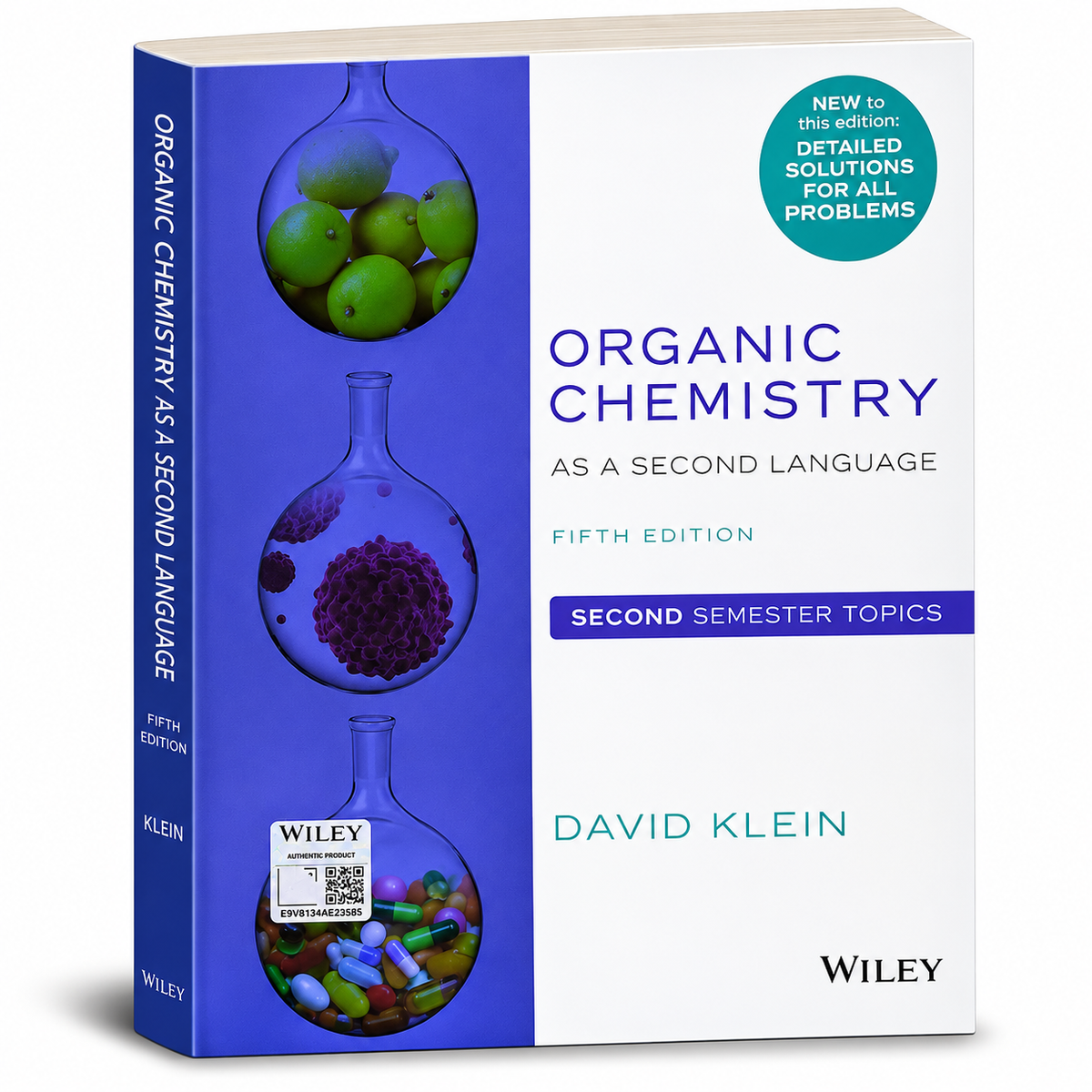
Organic Chemistry as a Second Language: Second Semester Topics, Fifth Edition

Organic Chemistry as a Second Language: Second Semester Topics, Fifth Edition

Amazon rating and customer reviews
Regular price $50.45
Sale price $50.45 Regular price $70.00
-28% Sold out
Taxes included. Shipping calculated at checkout.
Flat $1 OFF on your first order
VISA AMEX
Publisher: Wiley
Author: David R. Klein (Author)
Format: Paperback
  • Delivery within 3-7 business days
  • Free shipping Worldwide
  • Free 15 Days Returns
🏷️

Exclusive Offers For You

Choose your offer and copy the code!

SPECIAL OFFER

2% OFF

On orders above $999

BESTSELLER DEAL

5% OFF

On orders above $1999

*Applicable to eligible products. Minimum purchase required.

✓ Coupon code copied successfully!
Quantity
Bulk Inquiry

🚚 Choose Shipping Preference

Choose your preferred shipping option.

About Book

ABOUT THE BOOK

Organic Chemistry as a Second Language: Second Semester Topics, Fifth Edition by David R. Klein is a comprehensive learning resource designed to help undergraduate students understand and master the more advanced concepts of organic chemistry. Building on the foundational principles covered in the first semester, this edition focuses on molecular structures, reaction mechanisms, chemical transformations, and analytical techniques that are essential to succeeding in a second-semester organic chemistry course.

The book is organized into ten chapters covering major areas of advanced organic chemistry. It begins with Aromaticity, introducing aromatic compounds, nomenclature, and the criteria for aromatic stability. The following chapters explore IR Spectroscopy and NMR Spectroscopy, explaining how to interpret molecular structures, chemical shifts, signal intensity, integration, and splitting patterns. It then examines Electrophilic Aromatic Substitution and Nucleophilic Aromatic Substitution, including reaction mechanisms, directing effects, activation, deactivation, and synthesis strategies.

Further chapters focus on Ketones and Aldehydes, covering carbonyl chemistry and reactions with different nucleophiles; Carboxylic Acid Derivatives, including acid halides, anhydrides, esters, amides, and nitriles; and Enols and Enolates, exploring keto-enol tautomerism, aldol reactions, Claisen condensation, alkylation, and Michael reactions. The final chapters address Amines, including their preparation and reactions, and Diels–Alder Reactions, explaining important mechanisms and pericyclic chemistry.

A defining feature of this fifth edition is its skill-building approach, which emphasizes understanding chemical principles rather than relying on memorization. The author breaks complicated subjects into manageable steps and uses clear explanations, practical examples, and problem-solving strategies to help students recognize reaction patterns and predict chemical outcomes. Hands-on exercises and detailed, fully worked solutions provide opportunities to practice concepts and evaluate understanding.

The book also includes a dedicated detailed-solutions section and an index, making it easier for students to review difficult topics, check their reasoning, and strengthen their problem-solving abilities. Its accessible writing style makes challenging organic chemistry concepts more approachable for learners at different levels.

Ideal for undergraduate chemistry students, pre-medical students, and anyone studying second-semester organic chemistry, this textbook serves as an effective supplement to a primary organic chemistry course book. It provides the conceptual understanding, practice, and analytical skills needed to approach advanced chemical reactions and synthesis problems with greater confidence.

About Author

ABOUT THE AUTHOR

David R. Klein, PhD, is an accomplished chemistry educator, author, and academic specializing in organic chemistry. He has served as a Senior Lecturer and Fellow-by-Courtesy in the Department of Chemistry at Johns Hopkins University, where he taught organic and general chemistry for more than three decades. He has extensive experience working with students from diverse academic backgrounds and understands the common challenges they face when learning complex chemical concepts.

Dr. Klein earned his bachelor's degree in Chemistry from Johns Hopkins University and his PhD in Organic Chemistry from the University of California, Los Angeles (UCLA), where he studied under Professor Orville Chapman. His teaching philosophy emphasizes understanding fundamental principles, developing problem-solving skills, and applying chemical knowledge rather than relying solely on memorization.

He is widely recognized for his innovative SkillBuilder approach, which breaks challenging chemistry topics into manageable steps and helps students develop confidence in solving complex problems. His conversational writing style, practical examples, and use of relatable analogies make difficult scientific concepts easier to understand.

Dr. Klein is the author of several respected chemistry textbooks and study guides, including Organic Chemistry, Organic Chemistry as a Second Language, and General Chemistry as a Second Language. His publications are widely used by undergraduate students and instructors seeking effective approaches to chemistry education.

Through his teaching, research, and educational writing, David R. Klein has made significant contributions to helping students understand chemistry and develop the analytical skills needed for academic success.

View full details

DESCRIPTION

Organic Chemistry as a Second Language: Second Semester Topics, Fifth Edition by David R. Klein is a student-friendly study guide designed to make advanced organic chemistry easier to understand and apply. Rather than relying on memorization, this book presents organic chemistry as a connected system of concepts, reactions, and mechanisms, helping students develop the reasoning skills needed to solve challenging chemical problems.

This edition builds on the fundamental principles introduced in the first semester of organic chemistry and explores more advanced topics, including aromatic compounds, infrared (IR) spectroscopy, nuclear magnetic resonance (NMR) spectroscopy, electrophilic and nucleophilic aromatic substitution, aldehydes and ketones, carboxylic acid derivatives, enols and enolates, amines, and Diels–Alder reactions.

The book follows a step-by-step, skill-building approach that encourages students to understand why chemical reactions occur rather than simply memorize reaction patterns. Clear explanations, practical examples, and problem-solving strategies help readers recognize reaction mechanisms, interpret spectroscopic data, predict products, and approach complex organic synthesis questions with greater confidence.

A major strength of this edition is its emphasis on active learning and practice. Numerous exercises, worked examples, and thoroughly explained solutions reinforce important concepts and allow students to evaluate their understanding as they progress through each topic. The informal writing style and helpful teaching analogies make difficult material more accessible and easier to retain.

Ideal for undergraduate chemistry students, pre-medical students, and learners taking second-semester organic chemistry courses, this guide is an excellent companion to a standard organic chemistry textbook. It provides an effective approach to mastering advanced concepts, improving problem-solving abilities, and building a stronger foundation in organic chemistry.

Frequently Bought Together

Loading recommendations...

Total Price: —

Wide Range, Authentic Books, Fast and Reliable Delivery, Safe and Secure Payments