Skip to product information
1 of 2

TheeliteBooks.com

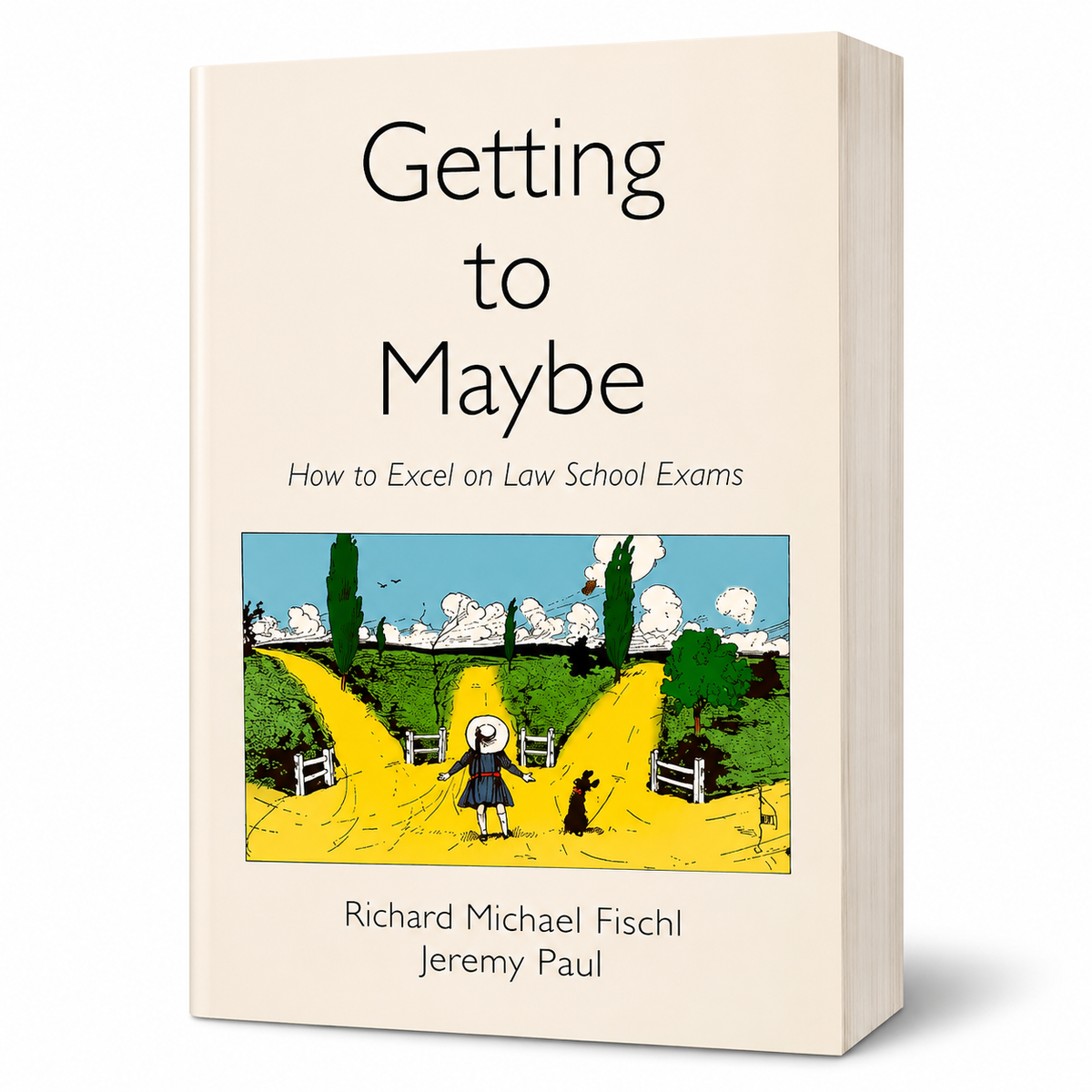
Getting to Maybe: How to Excel on Law School Exams

Getting to Maybe: How to Excel on Law School Exams

Amazon rating and customer reviews
Regular price $3,510.00
Sale price $3,510.00 Regular price $4,655.00
-25% Sold out
Taxes included. Shipping calculated at checkout.
Flat $1 OFF on your first order
VISA AMEX
Publisher: ‎ Carolina Academic Press
Author: Richard Michael Fischl (Author), Jeremy Paul (Author)
Format: Paperback
  • Delivery within 3-7 business days
  • Free shipping Worldwide
  • Free 15 Days Returns
🏷️

Exclusive Offers For You

Choose your offer and copy the code!

SPECIAL OFFER

2% OFF

On orders above $999

BESTSELLER DEAL

5% OFF

On orders above $1999

*Applicable to eligible products. Minimum purchase required.

✓ Coupon code copied successfully!
Quantity
Bulk Inquiry

🚚 Choose Shipping Preference

Choose your preferred shipping option.

Categories: Education , Law

About Book

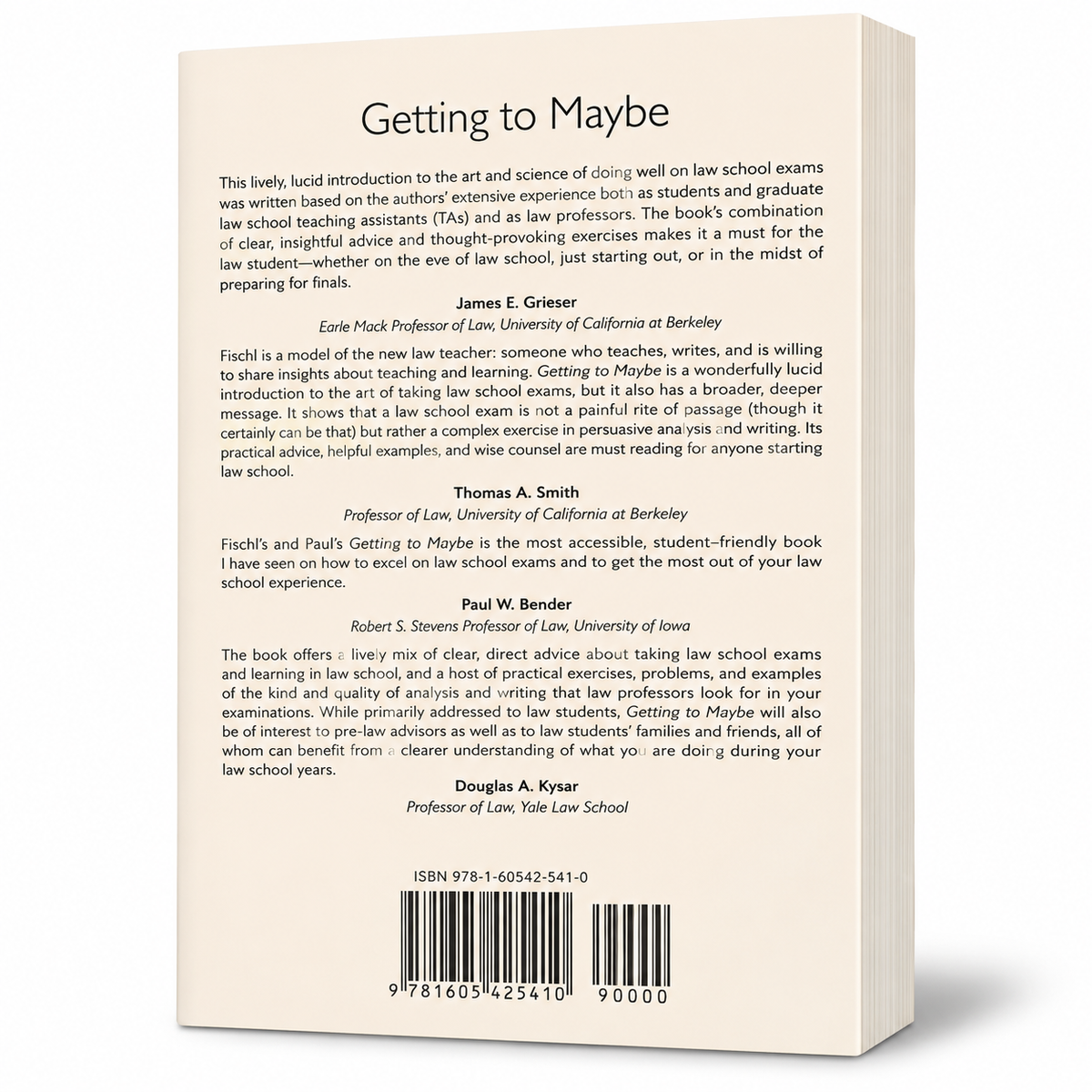
Getting to Maybe: How to Excel on Law School Exams by Richard Michael Fischl and Jeremy R. Paul is an insightful and practical guide designed to help law students understand the challenges of legal education and develop the analytical skills necessary to succeed in law school examinations. The book introduces readers to the distinctive style of legal thinking and explains why success in law school requires more than memorizing legal rules, cases, and statutory provisions. It emphasizes the importance of critical thinking, intellectual flexibility, and the ability to recognize and evaluate multiple perspectives when approaching complex legal questions.

The authors explain how law school examinations are structured to test a student's ability to identify legal issues, interpret complicated facts, apply relevant legal principles, and develop convincing arguments. Rather than searching for one simple or definite answer, students are encouraged to explore different possibilities, recognize uncertainties, and understand how reasonable legal arguments can lead to different conclusions. This approach helps readers develop the ability to think critically and analyze legal problems from multiple viewpoints.

One of the central themes of the book is learning to think like a lawyer. Through practical examples, explanations, and examination-oriented guidance, the authors demonstrate how students can identify hidden legal issues, distinguish important facts from irrelevant information, recognize competing interpretations, and construct well-supported arguments. The book also explores the importance of understanding legal concepts in depth rather than relying on memorization alone.

In addition to developing legal reasoning skills, the book provides valuable insights into effective study habits, examination preparation, time management, and organizing legal knowledge. It helps students understand what professors expect in law school examinations and how to communicate their reasoning clearly, logically, and persuasively under examination conditions.

Written in an engaging, accessible, and thought-provoking style, Getting to Maybe: How to Excel on Law School Exams is a valuable resource for first-year law students, advanced law students, pre-law students, and anyone interested in improving their legal analytical abilities. Whether preparing for challenging examinations or building a stronger foundation in legal reasoning, this book offers practical strategies and a fresh perspective on how to approach legal problems with confidence, clarity, and intellectual depth.

About Author

About the Authors

Richard Michael Fischl is a distinguished American legal scholar, professor, and experienced educator specializing in labor law, legal theory, and legal education. He serves as the Constance Baker Motley Professor of Law at the University of Connecticut School of Law. He earned his Juris Doctor degree from Harvard Law School and his undergraduate degree from the University of Illinois at Urbana-Champaign. Before entering academia, he worked with the National Labor Relations Board, where he gained valuable experience in labor law, litigation, and appellate legal practice. He previously taught at the University of Miami School of Law for more than two decades, earning recognition for his outstanding teaching and academic contributions. His research and teaching focus on legal reasoning, employment law, collective bargaining, and the development of critical analytical skills among law students.

Jeremy R. Paul is an accomplished American legal scholar, professor, author, and former law school dean. He is a Professor of Law at Northeastern University School of Law and previously served as its dean from 2012 to 2018. He earned his undergraduate degree from Princeton University and his Juris Doctor from Harvard Law School. His academic expertise includes constitutional law, jurisprudence, property law, and legal education. Before joining Northeastern University, he spent 23 years teaching at the University of Connecticut School of Law, where he also served as dean and Professor of Real Property Law. His scholarly contributions have appeared in several respected legal journals, and he is widely recognized for his ability to explain complex legal concepts through accessible and engaging approaches to legal education.

Together, Richard Michael Fischl and Jeremy R. Paul bring extensive academic knowledge, professional experience, and teaching expertise to Getting to Maybe: How to Excel on Law School Exams. Their collaborative work has helped generations of law students develop stronger legal reasoning, analytical thinking, and examination skills. Through their writing, they provide practical guidance for understanding the complexities of legal education and approaching law school examinations with greater confidence.V

View full details

Getting to Maybe: How to Excel on Law School Exams by Richard Michael Fischl and Jeremy R. Paul is a highly regarded guide designed to help law students understand the unique challenges of law school examinations and develop stronger legal analytical skills. Rather than focusing solely on memorizing legal rules and searching for straightforward answers, this book teaches students how to approach complex legal problems, recognize uncertainty, and construct thoughtful arguments based on careful legal reasoning.

The book explains the fundamental differences between traditional academic examinations and law school exams, where students are often required to analyze ambiguous facts, interpret legal principles, and consider multiple possible outcomes. It demonstrates how successful legal analysis involves identifying important issues, understanding competing arguments, evaluating different interpretations, and presenting well-reasoned conclusions.

A central focus of the book is developing the ability to think like a lawyer. Through practical examples and detailed explanations, readers learn how to recognize hidden legal issues, identify important distinctions in facts, analyze opposing viewpoints, and apply legal concepts effectively to examination questions. It also explains how to argue both sides of a legal issue without appearing uncertain or indecisive.

In addition to legal reasoning techniques, the authors provide valuable guidance on studying, exam preparation, time management, organizing legal knowledge, and improving written examination responses. The book encourages students to move beyond simply reproducing information and instead develop the analytical approach necessary for success in legal education and professional practice.

Written in an engaging, accessible, and intellectually stimulating style, Getting to Maybe: How to Excel on Law School Exams is an essential resource for first-year law students, advanced law students, pre-law students, and anyone seeking to strengthen their understanding of legal analysis and examination techniques.

Whether preparing for challenging law school examinations or developing the foundations of professional legal reasoning, this book offers practical strategies and valuable insights to help readers approach legal problems with greater confidence, clarity, and analytical precision.

Frequently Bought Together

Loading recommendations...

Total Price: —

Wide Range, Authentic Books, Fast and Reliable Delivery, Safe and Secure Payments